Written for a coordinator
For teachers and coordinators
Schools at the farm
शिक्षकों के लिए — पहले यह पढ़िए
A day here is children in the beds rather than beside them: soil, water, compost, and what eats what, on five acres in the Aravallis about ninety minutes from Delhi.
You are deciding on behalf of forty children and you will be answerable if something goes wrong. So this page puts the awkward part first.
As this page stands, a school cannot responsibly book a visit here.
Seven things are settled. Fifteen things you would need to know are not. Supervision, first aid, drinking water, toilets, shade, the emergency plan, insurance, cost. None of them is hard for us to answer and none of them has been answered, so we are not writing them here as though they had.
What we can do today is let you see in two minutes where that stands, and make your first email the one that settles it.
- Where. Ladpuri, Khairthal-Tijara, Rajasthan — five acres in the Aravallis, about ninety minutes from Delhi.
- Who arranges it. Swechha, the environmental NGO that runs the farm. Visits go through Swechha, not through a booking form here.
- Best months. The cool months. January to April the orchard is in flower; Kinnow is ready in January.
- What grows. Eleven fruit species, of which eight or nine flower between January and April. Turmeric under canopy.
- What a day uses. Twenty-four vermicompost beds and nine irrigation zones off a single borewell — the closed loop a group walks end to end.
- What it teaches. Three things, set out below: what a child does, and what they come away with.
- Photographs of children. Our policy is below in full, and it is the one thing here you can rely on today.
- Group size, how many adults you need with you, timings and how long on site
- First aid, the nearest medical help, the emergency plan, a named contact for the day
- Drinking water, toilets and washing, shade and heat
- Food, allergies and dietary needs
- Consent forms and insurance — whose, and what they cover
- What the school brings and what the farm provides
- Coach access and the sand track
- Cost, and whether transport can be arranged
Each one is numbered further down, so you can work through them in a single email.
Fifteen open · nothing guessed
Safety, supervision
and facilities
सुरक्षा और सुविधाएँ
This is the section you read first, and it is the one where we have written down almost nothing. We have not estimated, rounded or guessed at any of it. You cannot plan on a guess, and offering you one here would do real harm.
- 1Group sizeHow many children can you take in a day, and does that change by season?
- 2Adults with the groupHow many adults do you need us to bring, and do your own people count towards that?
- 3TimingsWhen does a day start and end, and how long do you recommend we stay?
- 4First aidWhat is on site, where is it kept, and who there on the day is trained?
- 5The nearest hospitalWhere is it, how long does it take to reach, and is there a vehicle on site?
- 6If something goes wrongWhat happens if a child is hurt or missing, who takes charge, and how do you tell the school?
- 7Who we find on the dayOne person the lead teacher can go to, and how to reach them while on the farm.
- 8Drinking waterDo you provide it or do we carry our own, and where does it come from?
- 9Toilets and washingHow many, where, and can a whole group get through them in one break?
- 10Shade and heatWhere does a group sit out of the sun, and what do you do when it is hot?
- 11FoodDo you provide anything, do groups bring their own, and how are allergies handled?
- 12Consent and insuranceWhat do you need from us in writing before the day, what do you carry, and what must the school carry?
- 13What to bringWhat does the school supply and what do you? Footwear, hats, gloves, anything for the beds.
- 14Coach accessCan a coach reach the farm, where does it turn and wait, and what does the sand track mean for it?
- 15Cost and transportWhat does a visit cost a school, and can transport be arranged at all?
Until these fifteen are answered, a school cannot responsibly book.
That is not a disclaimer and it is not modesty. A coordinator who books a trip without knowing how many adults they need, where the nearest hospital is and what the toilets are like has not done their job. Every one of the fifteen is a decision we could make in an afternoon. None has been made.
No photograph of the shaded assembly point
Where a whole group actually sits down, with the shade and the seating visible, so you can judge it rather than take it on trust.
No photograph of the toilets and washing
The arrangement as it is. It is the first thing you will ask about and we cannot show it to you.
No photograph of the drinking water point
Where water comes from on the day, and what it is stored in.
These three are exactly the pictures you would want before trusting a place with forty children, and we have none of them.
Our policy
Photographs
of children
बच्चों की तस्वीरें — हमारी नीति
Most farm sites never say any of this and leave you to ask. This part is settled, and it holds whether or not the fifteen above are ever answered.
What we will and will not do
- The rule
- No photograph of a child is published without written permission from that child's parent or guardian. Not cropped, not from behind, not in the background of something else.
- Asked in writing
- Before the day, per child, through the school — naming where an image may appear and for how long
- Default framing
- If anything is photographed at all, it is framed so no face is identifiable unless that permission explicitly says otherwise
- No exceptions for “just the website”
- A farm's own site is publication. So is a social post and so is a printed leaflet.
- The visit we have
- A school came on 28 December 2022. Parents were asked and the permission is held, which is why those photographs are on this page. It is the only visit for which that is true.
What we still have to decide
A policy is only as good as what happens to the files afterwards, and that part is not written.
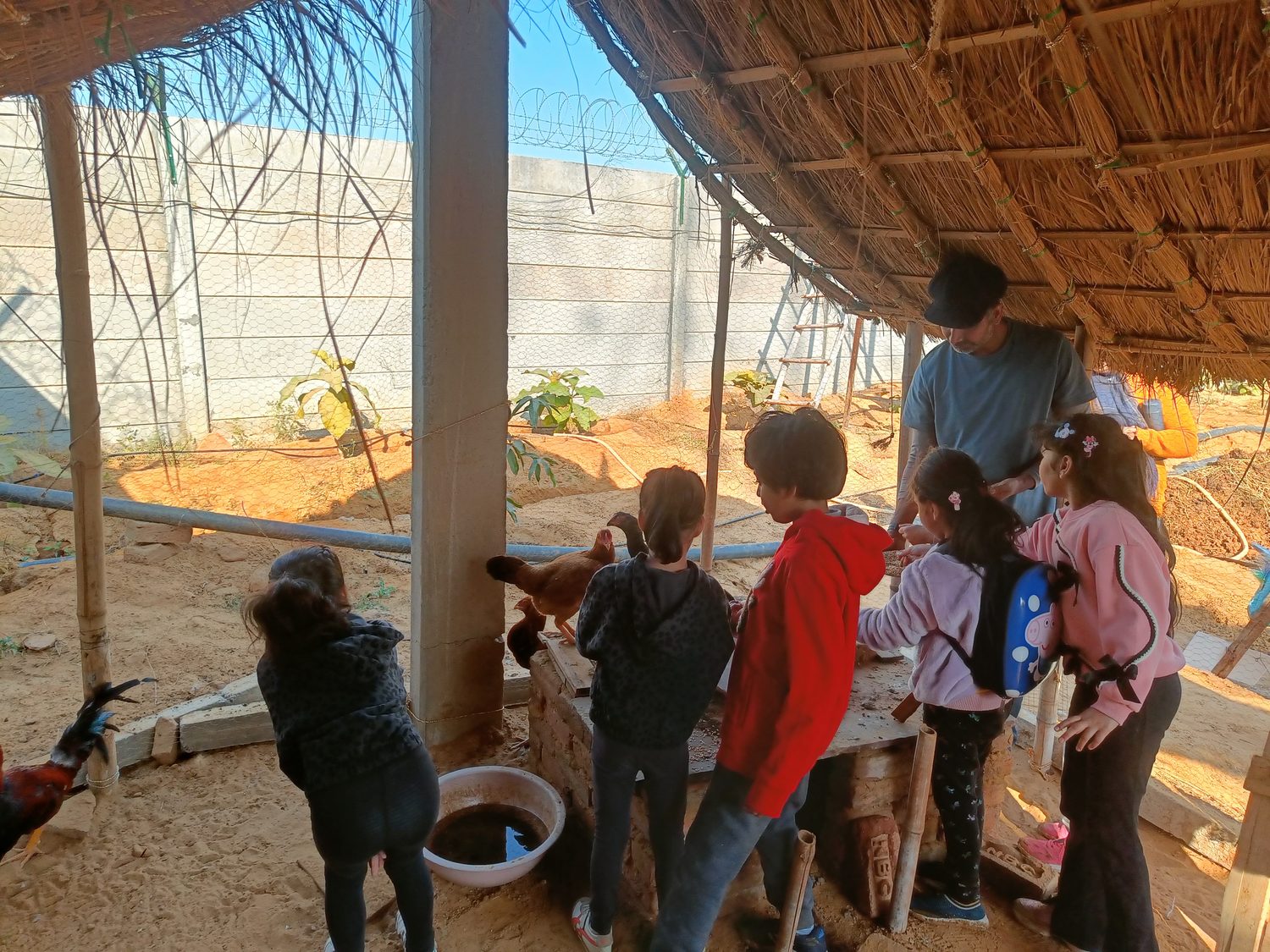
At the beds, hands in. Not a demonstration they stood and watched.
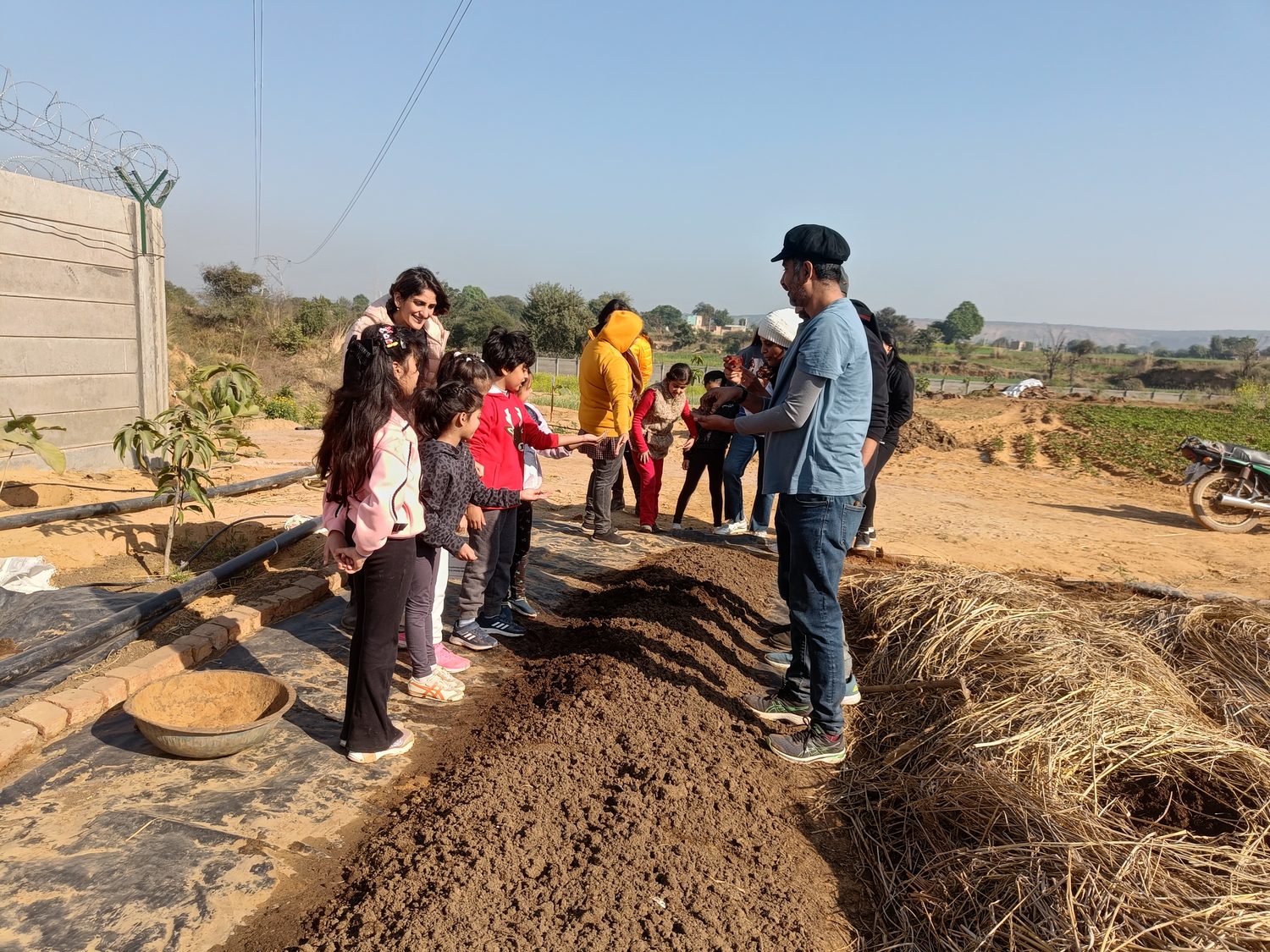
The compost heap. Most of a school day here is spent standing on the ground being talked about.
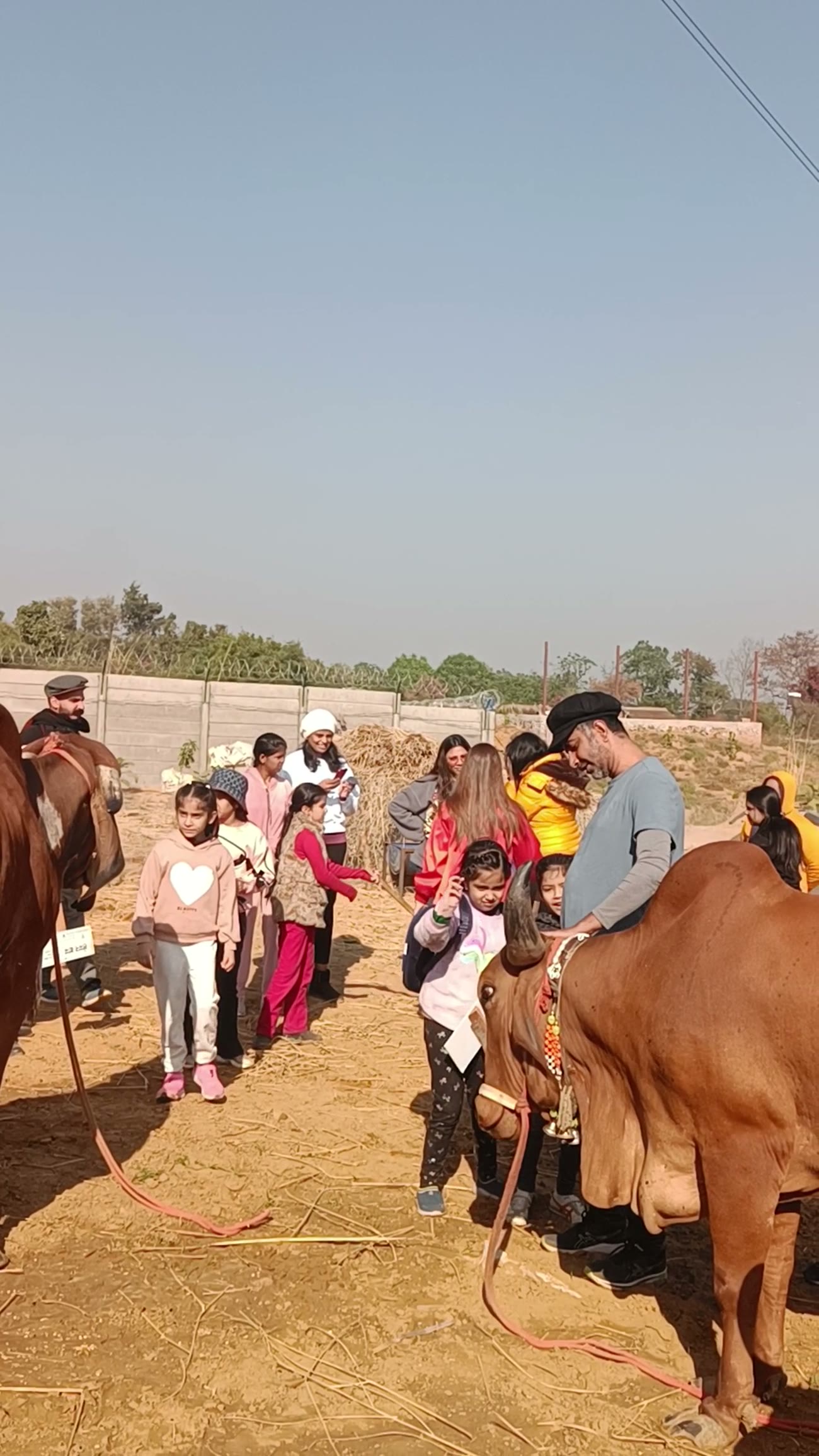
The herd, at a safe distance that is still close. This is the part they remember.
28 December 2022, the one visit whose permissions are on file. Everything a teacher wants to see in advance — the assembly point, the toilets, the drinking water — is still not photographed, and those are facilities rather than consent problems.
Learning, not a tour
What a group
actually does
A visit here is not a farm tour with a different label on it. Three things on these five acres teach something a classroom finds hard. For each one: what a child does, and what they come away with.
-
Walk a closed loop, end to end
A child opens one of the twenty-four vermicompost beds and puts their hands in it. Then they follow one of the nine irrigation valves out from the single borewell to the part of the field it feeds, and find the trees whose prunings went into the bed they just opened. The whole circuit is walkable in a morning.
What they come away withThat nothing here is thrown away, and that the thing feeding the trees is the thing the trees dropped. A loop you have walked is not the same as one you have seen drawn.
-
Count what is in a row, and watch it change
The orchard holds eleven fruit species and they are not in blocks. A child walks one row naming what is in it and finds that twenty metres along it has become something else. Between January and April they can see eight or nine of those species in flower at once.
What they come away withWhy a field of one thing and a field of eleven fail differently. A single-species block fails in one season to a single cause. A mixed one loses one of eleven.
-
Meet a record that can contradict the people who keep it
Our own software refuses to clear a spray date it cannot square with the apiary record. The bees live inside the citrus strip, ten colonies across about fifty boxes, and the orchard flowers January to April. It does not warn and proceed. It refuses. And the orchard's tree count went down when somebody finally walked the rows and counted.
What they come away withThat keeping a record is easy, and keeping one that can tell you that you were wrong is the hard part. A smaller, truer number beat a bigger, older one here. That is a lesson about evidence rather than farming.
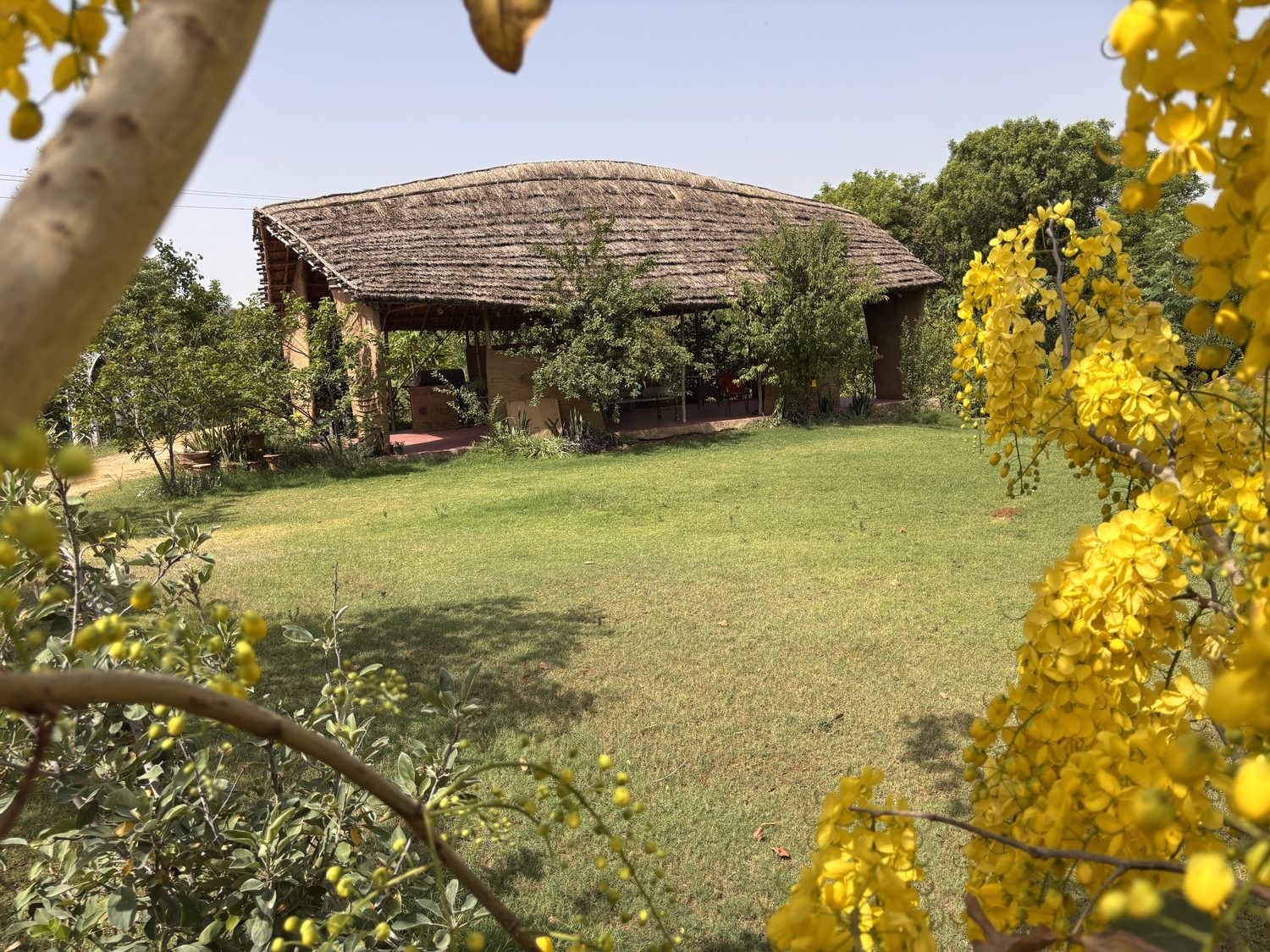
A thatched shelter on the farm, seen through an amaltas in flower. The only photograph on this page, and not a photograph of a school visit. We have none of those.
When to come, for a group
January to April does more teaching than the rest of the year
The orchard is in flower, Kinnow is ready in January, and the apiary is working the citrus strip, so two of the three lessons above are visible rather than described. These are also the cool months, which is our own answer to when it is good to be here.
Proposed · not yet made
Before the day,
and after it
Swechha already publishes a substantial curriculum resource, far more material than a single farm day could use. None of it is tied to farm visits yet. A visit you can prepare for with material you already have, and close with the same material afterwards, is worth several times one that arrives and leaves on its own.
What follows is a proposed shape for that, not a description of something that exists. Nobody has made the mapping yet, and we cannot write it from the farm's side alone.
-
Before
The teacher runs the units from Swechha's existing material that the day will put into the ground — soil, water, waste, growing. The children arrive already holding the vocabulary, so the farm day spends its time on the things only a farm can show.
Teacher · Swechha's material
-
The day
The three things above, done rather than read. The loop walked, the row counted, the record that refuses. We supply the place and the people, not the theory.
The farm
-
After
The class closes the unit with what they saw. The compost bed they opened becomes the example in the lesson they already had scheduled, which is how a day trip stops being a day out.
Teacher · Swechha's material
What has to happen first
Arranged through Swechha
Asking
Where it goes
School visits are arranged through Swechha, not booked here
We cannot take a booking here. Write to Swechha and ask, in the same email, for the fifteen above. One list gets you one reply rather than five rounds.
There is no telephone number on this site.
Put these in the first message
Seven lines that get you a straight answer
- School and your role
- A teacher, a coordinator and a head each need a different reply
- Children and adults
- Two numbers. It is the first thing we will want to know.
- Age range
- It decides which parts of the day work
- A month, and an alternate
- One date rarely survives a working farm's calendar
- Transport
- Whether the school brings its own, and whether it is a coach
- What you are teaching
- The unit this visit sits inside, so the day can be pointed at it
- Your list of the fifteen
- Ask for all of them at once.
The door
Ask for the
fifteen first
स्वेच्छा से संपर्क कीजिए
A straight answer to all fifteen is worth more to you than anything else on this page, and we could give it in an afternoon. Until we do, this page will keep saying so.